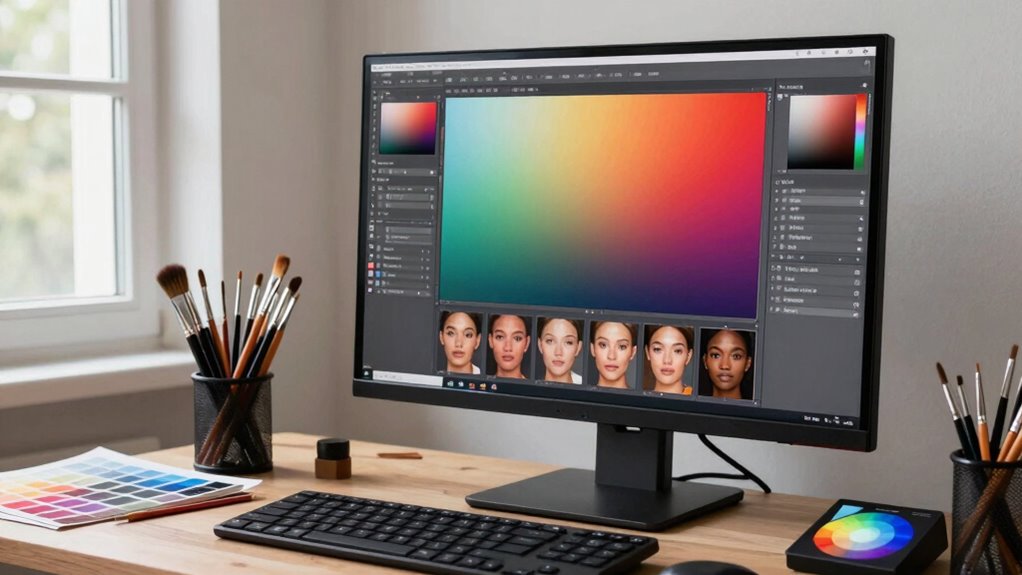
To guarantee color accuracy as a creator, focus on calibrating your monitor regularly with proper calibration tools like a colorimeter. This process aligns your display to industry standards, minimizing color discrepancies. Also, check your monitor’s color gamut coverage to confirm it can reproduce the full range of colors you need. Keeping these settings optimized ensures your work remains true-to-life and professional. Keep exploring to discover how to get the most precise color setup for your projects.
Key Takeaways
- Calibrating your monitor ensures accurate color reproduction aligned with industry standards.
- Use hardware calibration tools like colorimeters to create precise color profiles for your display.
- Regular calibration maintains consistent color accuracy over time, preventing shifts caused by display aging.
- Choose monitors with wide color gamut coverage (e.g., Adobe RGB, DCI-P3) for richer, more accurate colors.
- Proper monitor settings combined with calibration are essential for true-to-life color representation in creative work.

Ensuring your monitor displays accurate colors is fundamental for anyone working in design, photography, or video editing. When your colors are off, it can lead to flawed edits, inconsistent branding, or poor print results. To achieve true color accuracy, you need to focus on calibration techniques. Calibration involves adjusting your monitor’s settings to match a standard reference, which guarantees the colors you see on-screen are as close as possible to the original. Using hardware calibration tools, like colorimeters or spectrophotometers, makes this process straightforward and precise. These devices measure your screen’s output and help you create custom profiles that correct any discrepancies. Regular calibration, ideally once a month, keeps your monitor’s color output consistent over time, especially as displays tend to shift with prolonged use or age. Vetted calibration methods are recommended by professionals to ensure the highest accuracy. Beyond calibration, understanding your monitor’s color gamut coverage plays an important role in achieving accurate colors. The color gamut refers to the range of colors a monitor can display. When your monitor covers a wide color gamut—such as Adobe RGB or DCI-P3—you gain access to a broader spectrum of hues, which is essential for professional work that demands precise color matching. A monitor with limited coverage, like sRGB-only screens, might be suitable for basic tasks but can fall short in high-end creative applications. Check the specifications of your display to see how much of the color spectrum it can reproduce. If your work requires the most accurate colors possible, investing in a monitor with high color gamut coverage makes a significant difference. Combining calibration techniques with a deep understanding of your monitor’s color gamut coverage guarantees you’re working with the most accurate colors possible. Calibration aligns the monitor’s output to industry standards, while knowing the gamut coverage helps you select the right device for your needs. If your monitor lacks sufficient coverage, even perfect calibration won’t display certain colors accurately, leading to inconsistencies across your projects. As a result, it’s important to choose a monitor that supports the color spaces relevant to your work and to calibrate it regularly. This combo ensures your colors stay true, your edits remain consistent, and your final output looks exactly as intended.
Frequently Asked Questions
How Does Ambient Lighting Affect Monitor Color Accuracy?
Ambient light considerably impacts your monitor’s color accuracy by affecting your color perception. Bright or uneven lighting causes glare and reflections, making colors appear different than they truly are. To guarantee accurate color work, you should control ambient light, ideally using soft, consistent lighting that minimizes reflections. This helps your eyes perceive colors correctly and maintains the integrity of your creative work, especially when precise color matching matters most.
What Is the Best Calibration Tool for Creators?
You should use the X-Rite i1Display Pro for the best calibration tool. It offers precise color calibration and monitor profiling, ensuring your display shows accurate colors. Its advanced capabilities make it ideal for creators who need consistent and reliable color accuracy. With this tool, you can easily calibrate your monitor, maintain color consistency, and improve your workflow, resulting in more professional and accurate visual work.
Do Different Monitor Brands Have Varying Color Accuracy?
Ever wonder if monitor brand variations impact your work? They do. Different brands often have varying levels of color accuracy and consistency, which can make or break your creative projects. While some brands prioritize color fidelity, others may not offer the same precision. Choosing a reliable monitor brand guarantees you get consistent color accuracy, so you can trust your work looks just as stunning across all devices.
How Often Should I Recalibrate My Monitor?
You should recalibrate your monitor every 4 to 6 weeks to maintain ideal color accuracy. Regular monitor calibration routines help guarantee consistent results, especially if you notice color discrepancies. Use reliable color calibration software to streamline this process, adjusting settings as needed. Frequent calibration keeps your display accurate for editing and creative work, preventing color drift over time and ensuring your projects look just right across different devices.
Can Software Adjustments Improve Color Accuracy Without Hardware Changes?
Did you know that over 60% of color discrepancies can be improved with proper software calibration? You can enhance your monitor’s color accuracy without hardware changes by adjusting software calibration and using accurate color profiles. These adjustments fine-tune how your display reproduces colors, making your work more precise. Regularly updating and customizing your color profiles guarantees consistent and reliable color accuracy, even without new hardware.
Conclusion
So, you’ve finally embraced the wonder of color accuracy—congratulations! Now, you can confidently pretend your pixels are perfectly representing reality while secretly knowing it’s just a fancy illusion. Remember, in the world of creators, a monitor isn’t just a screen; it’s your magic wand for fooling everyone into thinking you’re a professional. So go ahead, tweak those settings, and keep the illusion alive—after all, who needs truth when you’ve got stunning reds?