
TL;DR

Get beauty and skincare favorites delivered free — and shop member deals
- Fast, free delivery on millions of items
- Access to Prime Big Deal Days deals on October 6–7
- Prime Video, Amazon Music and more included
Professional hair styling tools differ from drugstore versions mainly in motor durability and heat consistency, not magical features. Stay below 365°F (185°C) for most hair types, pick ceramic for fine hair and titanium for coarse hair, and expect diminishing returns above roughly $200 for home use.
Your flat iron has a temperature dial. Do you know what yours is set to? For a lot of people, the answer is “whatever it came at” — which is often hotter than a salon would ever use on you.
Professional hair styling tools exist for a reason: stylists run them eight hours a day, hundreds of clients a year, and they can’t afford tools that cook hair or die mid-shift. That engineering trickles down to what you buy for your bathroom counter — if you know what to look for.
In this guide for a smart, budget-conscious shopper, you’ll learn the key aspects to every major tool category, which technologies actually matter (and which are marketing glitter), and how to match specs to your specific hair type.
Stay below 365°F (185°C) for most hair types; sustained heat above 450°F (230°C) causes irreversible damage.
Match plate material to hair type: ceramic for fine or color-treated hair, titanium for thick or coarse hair, tourmaline for frizz-prone hair.
For home use, value plateaus around $200 — above that you’re paying for smart sensors, quieter motors, and brand prestige.
Maintain tools monthly: clear dryer lint, wipe cooled iron plates, oil clipper blades. It can stretch a 3-year tool to 5 years.
Air stylers like the Shark FlexStyle deliver most of the Dyson Airwrap’s low-heat benefit at roughly a third of the price.
The 5 Categories of Tools Every Stylist Relies On
Professional hair styling tools fall into five core categories of tools: blow dryers, flat irons, curling irons and wands, hot brushes and multi-stylers, and clippers or trimmers. Specialty salon gear — hooded dryers, steamers, chemical processing machines — matters for salon owners but not for your bathroom.
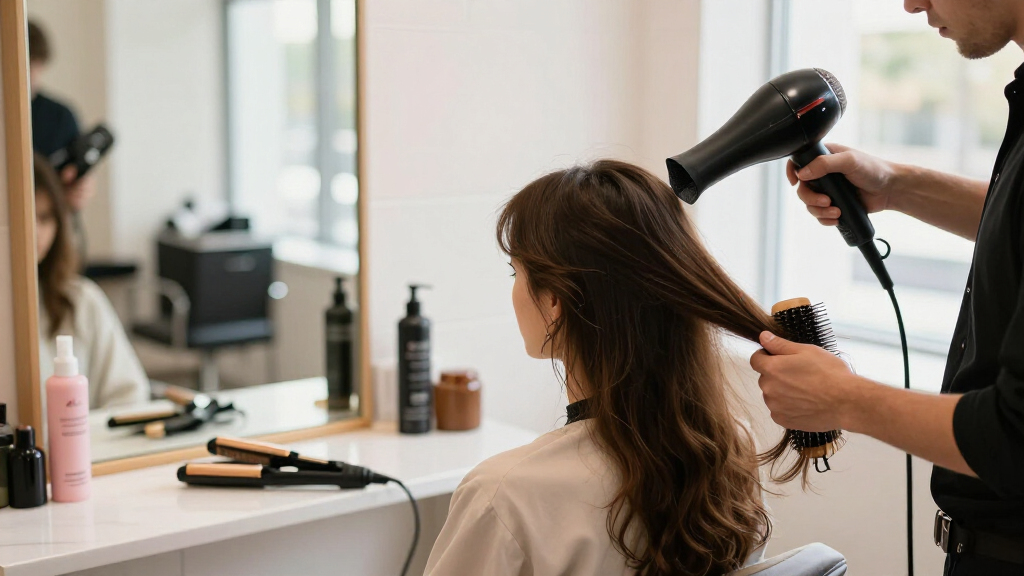
Walk into a working salon and you’ll see the hierarchy immediately. The dryer gets used on every single client, so pros gravitate toward workhorses like Parlux and Elchim — Italian-made dryers with AC motors rated for over 2,000 hours of use. Drugstore dryers typically use DC motors that fade within a year of daily use.
The iron situation is similar. A stylist might run a BaByliss PRO or GHD straightener through 20 heads of hair a day. The heating elements and plates have to survive that punishment without developing cold spots — the uneven heat that leaves one section of hair frizzed while the next goes flat.
- Blow dryers: 1800–3600 watts, AC motors, ionic or ceramic tech, plus attachments like diffusers and concentrator nozzles
- Flat irons: Ceramic, titanium, or tourmaline plates — the key spec is even heat distribution
- Curling tools: Barrels from 0.5″ to 2″; marcel irons (with rotating handles) are professional-only for a reason
- Hot brushes and stylers: The Revlon One-Step and Shark FlexStyle turned heated round brushes into a mass-market category
- Clippers and trimmers: Cordless lithium models from Wahl and Andis dominate barbershops
Ceramic vs. Titanium vs. Tourmaline — Which Plate Won’t Wreck Your Hair
Ceramic heats evenly and gently, titanium heats fast and hot, and tourmaline adds negative ions that cut frizz. That’s the whole cheat sheet — the plate material should match your hair type, not your budget.
Here’s the logic. Fine or color-treated hair does best with ceramic because it distributes heat like a cast-iron pan: slow, steady, no scorching hotspots. Thick, coarse, or textured hair often needs titanium, which transfers heat aggressively enough to straighten in a single pass instead of three.
Tourmaline — a gemstone crushed into the plate coating — emits negative ions as it heats. Those ions break down water molecules faster, which means less frizz and a smoother finish. Is it a gimmick? Partially real, partially inflated. Ionic tech genuinely reduces static; it just doesn’t justify doubling the price on its own.
| Material | Best For | Watch Out For |
|---|---|---|
| Ceramic | Fine, damaged, color-treated hair | Slower to reach temp; cheaper versions flake over time |
| Titanium | Thick, coarse, hard-to-straighten hair | Overkill — and risky — for fine hair |
| Tourmaline | Frizz-prone hair of any thickness | It’s a coating; it wears off on budget tools |
Rule of thumb: if your iron has only an on/off switch and no temperature dial, it probably runs at one fixed temperature — usually around 400°F+. That’s a gamble for fine hair.
The Temperature Numbers That Decide Whether Your Hair Survives
Stay below 365°F (185°C) for most hair types — that’s the widely cited sweet spot where hair styles without permanently damaging its keratin structure. Sustained heat above 450°F (230°C) causes irreversible damage, and no product can fully undo it.
Think of your hair shaft like a fiber ladder. Gentle heat bends the ladder into a new shape. Excess heat snaps the rungs. Once keratin bonds break down, the hair stays broken until it grows out or gets cut off.
Here’s how to translate that into dial settings:
- Fine or fragile hair: 250–300°F
- Medium/normal hair: 300–350°F
- Thick, coarse, or textured hair: 350–400°F
- Always: heat protectant spray first — it creates a buffer that can reduce moisture loss during styling
The newest tools handle this for you. GHD’s ultra-zone sensors and Dyson’s intelligent heat control measure the plate temperature 100 times per second and adjust automatically. You pay for that convenience — but it removes the single biggest variable in heat damage.
Why a $300 Dryer Might Outlive Three $40 Dryers
Professional tools cost $100–700+ versus $20–80 for consumer versions, and the difference comes down to three things: motor grade, heat consistency, and warranty length. A Parlux or Elchim dryer is built to run all day, every day, for years.
Does that mean you need one? Depends on usage. If you blow-dry daily, a professional dryer pays for itself in lifespan alone — the AC motor outlasts a consumer DC motor several times over. If you dry your hair twice a week, a mid-range “prosumer” tool like a Shark or Laifen gets you 80% of the benefit.
Heat consistency is the subtler difference. Cheap irons lose heat the moment hair touches the plate, then spike back up. You compensate by making more passes — and every extra pass is extra damage. A pro iron holds its temperature across the pass, so you style once and move on.
Where does the value plateau? Around $200 for home use. Above that, you’re buying motor silence (Dyson Supersonic), smart sensors, and brand prestige — real features, but diminishing returns unless you style daily or have demanding hair.
How Air Stylers Changed the Game (Without Hot Plates)
Air stylers — the Dyson Airwrap and its now-numerous imitators — shape hair using heated airflow and the Coanda effect instead of clamping it between 400°F plates. The result is styling at lower temperatures, which generally means less cumulative damage.
The Airwrap’s success spawned a wave of competitors: Shark FlexStyle, Laifen, and Tineco have made air-styling technology available at half the price or less. The Shark FlexStyle, at roughly $200, does a convincing impression of the $600 Airwrap for most home users.
Are they better for hair health? Generally yes, with caveats. Air styling still uses heat — just less of it, applied indirectly. If you have very coarse hair, you may find air stylers can’t deliver the glass-smooth finish a titanium iron can. The tradeoff is honest: less damage in exchange for less raw straightening power.
The prosumer shift is real, too. Brands that once sold only through salon distributors — BaByliss PRO, Hot Tools, CHI — now sell direct to consumers online. You can buy exactly what your stylist uses, no license required.
Keep Your Tools Alive: A 5-Month Maintenance Habit
Professional hair styling tools last 3–5 years if you maintain them, and maintenance is almost embarrassingly simple: clear dryer lint, clean iron plates, and oil clipper blades. Most people never do any of it.
Picture a dryer intake clogged with lint. The motor works harder, runs hotter, dies sooner — like a car driving everywhere with the parking brake on. Thirty seconds with a tweezers, once a month, can add years to the motor.
Your monthly routine takes about ten minutes total:
- Pull lint from the dryer’s rear filter (a toothbrush works well)
- Wipe iron plates with a damp cloth once fully cooled — product buildup causes uneven heating
- Oil clipper blades and run them for ten seconds to distribute
- Check the cord for kinks or exposed wire — a frayed cord is a fire risk, not a cosmetic issue
- Replace the tool when heat becomes inconsistent or plates flake, not when it dies completely
One travel note: most pro tools are not dual-voltage. Plugging a 110V American iron into a 220V European outlet without a converter will kill it instantly. Check the label before you pack.
Frequently Asked Questions
Are expensive professional tools really worth it?
Yes for daily users — professional motors and heating elements last years longer and hold temperature more consistently. But for home use, returns diminish above roughly $200. If you style twice a week, a mid-range prosumer tool delivers most of the benefit.
What temperature should I use for my hair type?
Fine hair: 250–300°F. Medium hair: 300–350°F. Thick or coarse hair: 350–400°F. Most hair types should stay below 365°F (185°C), and always use a heat protectant spray first.
Do ionic tools actually work, or is it marketing?
Ionic technology genuinely reduces static and frizz by breaking down water molecules faster — that part is real physics. But it’s a coating feature, not a miracle, and it doesn’t justify doubling a tool’s price on its own. On budget tools, the ionic coating can wear off within a year or two.
How often should I replace my styling tools?
Dryers typically last 3–5 years with regular use and monthly lint cleaning. Replace irons when plates flake, pull your hair, or heat inconsistently — cold spots mean uneven styling and extra passes, which means more damage.
Are air stylers like the Dyson Airwrap better for hair health?
Generally yes, because they style at lower temperatures using heated airflow instead of direct contact with hot plates. The tradeoff is power: very coarse or resistant hair may not get the pin-straight finish a titanium iron delivers. The Shark FlexStyle offers similar air-styling tech at a fraction of the Airwrap’s price.
Conclusion
Here’s the one thing to remember: the temperature dial matters more than the price tag. A $60 ceramic iron with adjustable heat, used at the right setting with protectant, will treat your hair better than a $400 tool cranked to max.
Buy for your hair type, maintain what you own, and check that dial before your next pass. Your hair keeps a record of every degree — make sure it’s a story it can survive.
Fall Picks
fall essentials
As an affiliate, we earn on qualifying purchases.